The 3 sketching supplies I recommend when you first start out.


Whether its a sketch book practice you are beginning on your own, or you are joining a sketching group such as urban sketchers, having the right equipment is probably already in your home! If you've been thinking about starting a sketchbook, the good news is you don't need a studio full of expensive supplies. In fact, these are the three things I reach for time and time again; a sketchbook , something to draw with and some paints.
Lets start with the sketchbook
Open amazon and search sketchbook and you will be bombarded with a ridiculous amount of choice.... size , weight of the paper, colour of the pages, soft cover, hard cover etc. Here's the two things about a sketchbook I reccomend for when you start out.
Stick to A5. The page size is not as daunting but if you want to sketch something bigger you can go across a double double page to get an A4 size (albeit with a page join down the middle!)
Your paper should weigh at least 120gsm. Less than that and using paints will be much harder.
When you are first starting out if you follow these principles you'll do fine. Heavier paper will always be better to paint on and you may find that some surfaces suit you better but don't over think it! Check that pile of notebooks on your shelf that you have never opened.... one of them may just fit the bill!

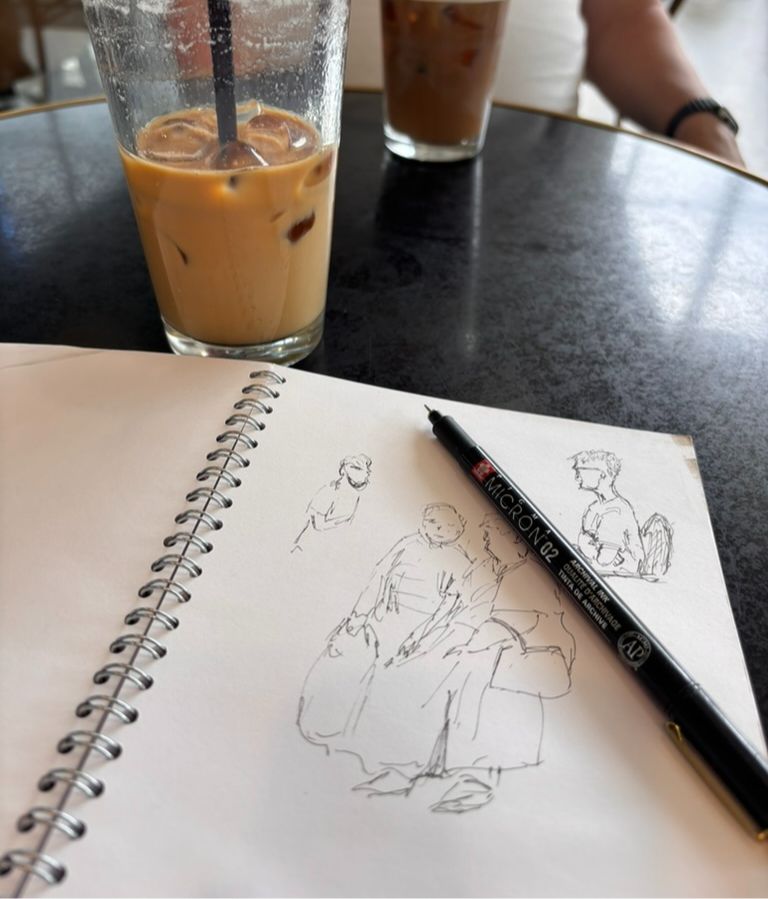
The blank notebooks I have on my website are ones that I also use for neurographic drawing and carrying around for coffee shop sketching or on journeys.
If you want something a bit more serious both the Fabriano sketchbook and the Stillman and Birn books are lovely to work with.
Don't keep them pristine on your shelf though.... scribble on that first page as soon as you get one.
Check your kitchen drawer for pens and pencils
Almost every house has a "clutter" drawer, one where pens and pencils loiter waiting for their moment! Your sketchbook is not a place for finished pristine drawings and paintings... drawing and sketching can help in ways we will never truly be able to measure. What is lurking that you can use straight away? Look for ideally for ...

A mechanical pencil rather than a normal pencil (saves you needing to sharpen it every few minutes)
A black biro or a waterproof black fine liner.
I don't actually use a pencil when I sketch. I used to ! but I found I got too worried about getting it right and wasted time rubbing out. Now I use a biro or a waterproof black fine liner...every mark is committed, there is no rubbing out. If I wanted a photo I'd take one. Using a pen means every mark is part of the story. I look more closely, judge myself less, and simply keep going if a line isn't in the right place. Using a pen also makes it easier to add colour over the top.
You don't need expensive paints to get started.
The one thing you are less likely to have already is paint. You don't need to use this at all though! ... I do like to use paint over the pen as a wash of colour to instantly adds depth to your picture. Again, there is a mind blowing amount of paints.
I use a combination of watercolours and gouache. Gouache has the advantage of being opaque so you can paint over lines more easily. Most of the time I use Windsor and Newton Cotman watercolour range...they do a lovely little sketching kit with basic colours in. Cheaper paints will have less pigment and wont be as light fast but for a sketchbook that can be all you need to give it a go. When you are feeling ready then the Windsor and Newton Professional colours are something completely different and you wont regret it.
What ever equipment you chose to begin with the most important part is to begin!


Comments